
Is the PMP losing its value?
I came across a couple pieces, one by Kareem Shaker and another by Derek Huether. They echoed some of my own sentiments about the real value of the PMI‘s PMP credential. I know first hand some PMP-holders who have no business running a project. They’ve passed the PMI’s test (which isn’t difficult for an experienced PM), and handed in application forms that were so light on detail they should have been flagged by the most perfunctory of glances.
The loss of intended value of a credential isn’t a new thing. Over the twenty years of my career I’ve seen it many times–particularly when the credential is managed by a for-profit body. The pattern seems to be as follows:
- For-profit body creates a new credential
- For-profit body markets credential, making success promises to hiring managers (who buy it)
- Hiring managers start to demand credential
- Shortage of credential-holders increases perceived value of credential
- Boot camps surface, making income promises to students
- Demand for credential waters-down the capability of the for-profit body to verify applicants
- For-profit body begins issuing certificates to anyone who can pass a test
- Intended value of the credential plummets
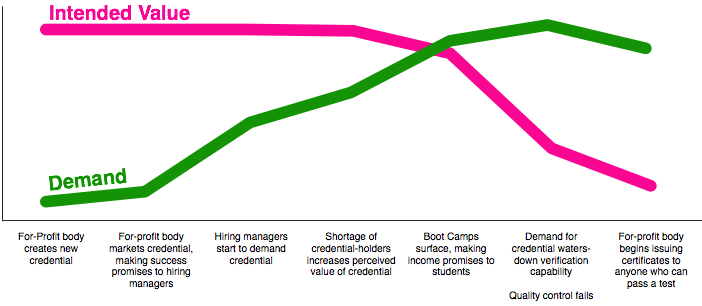
Of course, as hiring managers get wise to the fact their certificate-holding new hires can’t boil water let alone do what the certificate suggests they can, the demand for the certificate starts to wane. That has a couple effects:
1) The industry perceived value (and compensation) towards the certificate-holders’ discipline drops
2) The reputation of the for-profit certificate issuer drops
I know we’re in leaner times economically, and I’m hearing noise that suggests project managers are making less than they were a few short years ago. Is this related to a decrease in value of the PMP credential or simply the fact that times are tough?
I’m interested in what you think about the PMP. Does it continue to have value? Is the PMI doing a good enough job ensuring credential holders deserve the PMP? Is the industry watered down with too many PMP holders who can’t run a project? Or is the PMP an excellent credential that should give hiring managers confidence in their new hire?
What do you think?
Related articles by Zemanta
- May PMP Certification Numbers Are In (thecriticalpath.info)
- The Top 10 Reasons to be PMP Certified (teachstreet.com)
- What Is the PMP Graduate Credit Credential (brighthub.com)
- Ten Knowledge Areas Went Out to Dine…One Got Ignored and Then There Were Nine (edge.papercutpm.com)
- Buzzwords. Corporate Culture’s Greatest Monstrosities. (edge.papercutpm.com)






Ready to Feedback

[...] This post was mentioned on Twitter by Derek Huether, PMP, Geoff Crane. Geoff Crane said: is the pmp losing it's value? http://bit.ly/9XCNDl new blog post! [...]
Geoff, you're about to start me on a PMP rant that could possibly last for days! You nailed this on several levels. I'm going to zero in on just a few. Back in the late 90's, do you remember everyone and their mother had an MCSE certification? Every other commercial on the radio was from a boot camp offering easy MCSE certifications and job placement. Now it's PMP bootcamps.
We should accept that the certification is the lowest common denominator of any vertical. But what I see has happened, either by the training companies providing the certifications or by hiring managers demanding them, is an assumption of the polar opposite. People are believing the title of professional is synonymous with expert. It is not. The PMP and other certifications should state the holder of the certification demonstrates a minimum understanding project management vernacular and processes, as defined by PMI. If there was a practical exam to go with the written exam, perhaps it would weed out a few of the “paper” PMPs. On a business side, I believe in teaching the PMP basics to people. That's as far as I can go and still have a clear conscience. On a personal side, I talk about my past and present experiences and hope they can draw on that.
Best Regards,
Derek (the PMP)
http://thecriticalpath.info
http://pmprepflashcards.com
Heya Derek! Yah I figured this post would provoke a reaction *snicker*.
You're absolutely right that a certification should be indicative of the lowest common denominator of a vertical. However, that's never how certifications are marketed, are they?
My biggest concern with the phenomenon is that for-profit certifying bodies make promises. Oh sure, nobody would hold a certifying body accountable for an on-the-job screw-up based on marketing hype, but the promises remain. “If you have a PMP certified project manager, you can rest easy” is the message.
The boot camps that take advantage of the demand the fallacious marketing statements create also make promises. “If you get a PMP, you can make zillions of dollars as a project manager.”
If unchecked, these promises result in a body of unskilled people attracted by big salaries with credentials that attract hiring managers looking for an instant measuring stick (really, it's just like dominoes). So it comes down to the checking.
Based on what I'm seeing in the marketplace lately, the PMI isn't checking. I'm quite sure this has more to do with the fact that there's so many PMP applications out there and the PMI can only audit so many of them. That being said, if the PMI is going to make marketing promises to hiring managers, the PMI needs to ensure applicants make the grade.
I will say a PMP no longer has any appeal to me as a hiring manager for my projects. If I can't trust the credential, I'll look for other means to ensure my candidates can do the job I ask of them. If the candidates I choose have a PMP, that's more coincidence than criterion. I wonder how other hiring managers feel…
Update: I recently found this article by Kevin Aguanno at Project Times where he and his commentators discuss this in more depth.
Apparently Derek, you and I aren't the only ones who feel this way.
I agree with Derek that you have tried to address the issue at several levels. I'm commenting only on the process of getting certified.
I'm sure I can tutor a fresh college graduate (with no work experience) to pass the PMP exam in 1 month. Regarding the PMI audit, frankly speaking, it's a joke. I think the number of applications that are audited is not a percentage of the total applications, but a fixed number, and a very small one. I've seen people who have never managed any project, never seen a real project plan (let alone developing one), and have never done anything other than developing software, get PMP certified.
I started a blog last year hoping to help real project managers achieve and maintain their PMP certification. But I have started to develop a feeling that I'm doing more disservice to the PM Community, by making it easier for “unqualified” people to get PMP certified.
Anyway, thanks for bringing this topic up.
Harwinder
http://www.deepfriedbrainpmp.com
Geoff,
You may well be right but this is not limited to the PMP.
Think of the early ages of programming or the introduction of a new technology; in both cases you eventually get a flood of cheap knock offs (every one can program, 5000 flavors of ERP) which as good and bad consequences.
On the good side the increased offering drives the prices down and increases adoption; if there were only 3 good PMs in the world there would not be a positive impact. On the bad side lost of garbage gets sold and this may kill the opportunity. Eventually, there is self regulation and the offering decreases through consolidation.
In the case of the PMP I think that many who got certified only for the 3 letters after their name will drop off because of the PDU requirements. I know at least one guy who can't motivate himself to read a book or listen to webinars and who will most likely lose his credentials.
Patrick Richard ing., PMP
http://www.thehardnosedpm.com
@hardnosedpm
http://www.heavyrotations.com
What an enlightening comment, Harwinder, thanks so much for that! Based on your circumstances, you're in a better position to judge the efficacy of the PMI's audit processes than most of us.
It's disturbing to me that you're not seeing more audits being done. From my perspective, it's the audits that demonstrate the value of the PMP credential–the test doesn't require experience to pass!
Thanks for more great insight, Patrick! I think you're right that this is normal behaviour for any certification program.
The PDU process disturbs me a little. I can see the value of having certificate-holders continue to demonstrate their PM contributions. But it makes the assumption that the pool of PMP holders is undiluted–that PMP holders are experienced and adept PMs.
If the pool of PMP holders IS diluted, because the PMI doesn't audit enough of its applicants, is the push to take time away from hectic projects and other things in order to make the cut off worth it? I know a few people who have lost their credentials this way.
Or perhaps you're right, and the PDU requirements are an effective way of regulating the pool. I don't know.
Hey Geoff
OK so you've managed to pushed my button with this one as I know you knew you would
I want to pick up on the point about “Hiring managers start to demand credential” 'cause this bit drives me nuts. Hiring managers seem to be under some sort of spell and often as not are demanding a credential because they don't know what it is they need to hire. So just like the MCSE (gawd Derek I remember having to hire based on that!) or whatever TLA you want to insert, it's a bit of a safety net, ie: if I hire someone with that then they're bound to be 'good' so I won't have to invest much. Eeeh wrong!
Unfortunately this is usually where those we probably class as 'accidental' PM's (like me) get the distress call and parachute in like a SWAT team to sort things out. I'm absolutely not saying all PMP's are 'poor'. What am I saying is that as a consequence of demand and supply the pool must inevitably become diluted. And have those hiring managers learned yet? No and they won't until they and others (their little recruitment helpers) understand the difference between a credential and experience.
I'm done.
Deanne
http://www.unlikebefore.com
@UnlikeBefore
http://www.unlikebefore.blogspot.com/
Great discussion!
When I started in IT (as desktop support) it seemed everyone had an A+ and/or MCSE around me, yet I was the one closing most of the tickets and being asked for personally by the executives. As I moved up to project management I started seeing the PMP in peoples signatures. I had never gotten a cert before and it hadn't slowed my down, so I didn't really think I needed the PMP either. Over the 10 years or so of running projects and working with colleagues or vendor PMs I really started to notice that some folks with a PMP shouldn't run a hot dog stand! It wasn't until my employer said “Robert, we are going to pay for you to get your PMP” did I jump on board.
I have to say that I did learn some great stuff during that 4 day boot camp and have since worked some tools/techniques into my 'toolbox'. However, I have also learned a great deal from following some of you on twitter…so what's the difference? For me it is the audit, the experience you need to get a PMP. MSCE, A+, etc don't require a single day of experience…the PMP needs some thousands of hours. As an employer that is my insurance that this guy/gal knows what they are doing (they take a test, require 35hrs of formal class work, and needs 2500hrs of experince)
Unfortunately…most employers don't know what Project Management really is and the PMI has fallen down on the job of audits. So now we are left with PMPs that should never have been allowed to sit for the exam and employers that have incorrect expectations of what the PM value is. The PMI needs to refocus its efforts from expansion back to quality – stop pumping your chest about the new chapters around the world and start working to educate employers on the value, role, and standards of PM. They need to reallocate resources to the 'audit board'. All issues for a for-profit org.
HAHA Deanne thanks so much for commenting and welcome back!
Of course I was pushing buttons. @tykiisel called me a pot stirrer. LOL
It's a bit of a vicious circle, isn't it? Hiring managers want fast and easy answers so certifying bodies respond with ultimately impossible promises. Of course, certifying bodies aren't accountable for the decisions hiring managers make, and hiring managers eat those promises right up. “Yay! That promise means I don't have to think!”
The slaps upside the head need to go out all around the marketplace, not just in one direction.
Hey Robert thanks so much for joining!
I agree the PMI audit is the signature element that makes the certification important. I also agree the PMI isn't doing a good enough job in that area. Less than a year ago I found myself staring in horror at a PMP application that contained the following three line items:
* identified stakeholders – 10 hours
* got approval – 20 hours
* project execution – 2100 hours
That's it. That's all. I'm not kidding. The applicant in question received a PMP the following week. Why? Because he could pass the test. Either that, or the PMI actually considers the above line items a suitable representation of experience.
I think you have a very good point that the PMI should start focusing on quality once again. The question is, has the pool become so diluted it doesn't matter anymore?
Hi Geoff,
I think having a certification is crucial these days because it helps weed out those who don't have any technical knowledge. I hear what you're saying – we'd all value experience, right? But then again, if you have a PM with twenty years of experience, why in the world wouldn't the PM have some sort of certification?
Also, there are people out there operating as “project managers” and even have that title, yet they zero knowledge of project management. I think it's a good thing for certification to be there, overall. I think having a PMP should give you an edge.
But let's say you went to college and got an engineering degree. What if you made it all the way through just to pass and have the degree? If you didn't work hard and pay attention, would you be a useful hire? No!
That is a good question and one I am not really sure about to be honest. Could the PDU thing have an effect? Maybe/hopefully some folks won't actually submit the requirements and then lose the credential.
Many of the Execs and Sr Mgmt folks I have come across, really don't know project management and I have never really heard the PMP questioned so much as the actual PM or the overall practice itself. Trying to find hard numbers on the industry is very difficult…how many PMs are there? What % is PMP certified? What is the performance of success of a non-certified vs. certified PM? I could on about geographical breakdowns, industry representation, higher education, and so on.
I guess my point is that most of the questions I have heard are around the PM discipline vs. the actual certification.
I'm probably going to either looking like a troll, from all of my comments on this post. But, this topic can get me incited. I had to pass the PMI audit. Maybe that's why I'm such a hardliner when it comes to believing in the audit.
To focus on the experience requirement, PMI requires at least one (yes one) hour in each of the 5 defined process groups. So much for balance.
I have to agree with PMI on the PDU requirement structuring. For those laggards out there who can't keep up on their PDUs, there's a simple solution. Get involved! I'm not one to go to a PMI mixer. But, I've been to #pmot (project managers on twitter) meetups and I loved it. What's my point? PMI will give you a PDU for showing up for one of their meetings. But, if you host a round-table, do a presentation, or even publish, you get a lot more PDUs. PMI even awards you PDUs if you are employed as a project manager. Again, what's my point? I think it's almost hard to not get enough PDUs.
Wow I had no idea the experience requirement was so little. How on earth can you be expected to manage with only one hour of experience in each process group? “I attended the kick off meeting”….does that count as an hour in Initiation?
This falls under MINIMUM requirement criteria. To answer your question, in the eyes of PMI, I think it does count. What I find disturbing is I have been approached by people who are not in the project management field who are prepared to leverage situations like that to get their experience credit. If I ever find out they become PMPs, I will whistle-blow on their asses in a heartbeat. That being said, I'm really curious how PMI handles whistle-blowers. I think I will reach out to my PMI insiders and write a blog post about it.
Heya Laura, and thanks for stopping by with another great comment!
I can think of plenty of PMs without certifications (myself included)…twenty years ago a PMP wasn't really something you “got”. That demand didn't really pick up until about ten years ago or so, and by then many of us were hip deep in work, and the balance of spending extra time certifying didn't seem to offset the reputation for getting work done we'd built for ourselves.
I've never really dissed certifications, though…they have a place as a measuring stick. But what does that stick measure is really the question. When the PMI sends the message that the PMP carries a stringent audit, there's a certain expectation that the stick measures a high level of competence in that discipline.
Of course it's really a comedy of errors all over the place; as Deanne says below, hiring managers don't necessarily understand the difference between a credential and experience.
I THINK we would all agree on a few points…
1) The PMI process does have some flaws
2) Employees need to use the PMP as one aspect in the overall hiring criteria
3) There are some very poor PMP certified project managers
I would like to hear some thoughts on an 'ideal' system
ZOMG you totally have to dish when you find that out!
Hrm. That is disturbing actually. But I guess it should be expected. If the requirements are so low that it's possible to slip in with no effort, why wouldn't you if it might give you an extra edge?
It also explains why some of the applications I've seen recently have been so galactically sketch.
I seem to remember the last time I actually considered applying for a PMP the requirements were much more stringent. But maybe that's just a faulty old man's memory.
I bet Derek would have some sharp insights into an ideal system, as he's very close to this. (Way more than I am).
From my perspective the only way I can see it working is if the number of PMPs issued are throttled and the number of audits increased. But others may have better ideas. And the PMI still has to make money.
Hi, Jane, and thanks for joining the conversation.
The hiatus from work is always a tough one. I'm not sure if what you're describing is ageism or more the fact that there was an extended break in your friend's career, during which time the environment changed. You see this even when you're still working, but have been with one company for a long time…the rest of the world moves on and you're stuck either playing catch up or making personal changes to be able to stay marketable.
I don't have a good answer for your friend, but my best advice would be to leverage old relationships that she may still have to get herself a foot in the door, and work on career development concurrently. It's tough getting back into the job market and I wish her the best of luck!
Theoretically, PMI checks experience prior to allowing you to participate to the exam. Not sure the requested references are still checked as I've seen quite some young and less experienced project managers taking and passing the exam. In my opinion, the use of training organizations knowing the kind of questions that are asked very well is another reason for this “success”. Today, the PMP credential proves that you master the terminology and you have some minimal insight in a few project management techniques. About the one hour experience requirement I read about below, I understood that much more is required (bit what's the value of it if experience is not appropriately checked …).
Thanks for the comment, Wijns, and welcome!
I had thought the requirement was much more stringent as well, but Derek keeps a pretty close eye on PMI requirements so I'm inclined to take him at his word. I know for a fact people are submitting applications that sketch and passing.
I think you're absolutely bang on that today, a PMP demonstrates you have a loose grasp of the project management field. The problem is, what do the hiring managers believe?
I understand that the PMP certification hasn't always been there; I still think every project manager should have one. I also am fully aware that experience speaks volumes; in a case such as yours, a decent hiring manager would take you over the fresh-off-the-boat kid with a PMP cert any day. But the reality is that a lot of people w/out experience are applying for PM jobs and one way to cut to the chase is to weed out those w/out a cert.
However, even the brightest person new to project management who studied and passed the exam won't be as good as somebody with many years of experience. Flip the coin – that rookie might have learned some things the others don't know. Everyone is valuable and brings positives to the table.
This complements very well what I wrote a while ago: What You Will NOT Earn From a PMP Certification.
Generally, certifications are proof you've read and memorized well some content. They are not proof you are great at something. True experience and real-life results matter much more than any certification in this world.
Great post Geoff. I'd like to hear how the PMI would respond to your questions.
I'd like to hear that too! LOL I wonder if anyone from the PMI will respond.
I first joined the PMI in 1998 and started to look into getting my PMP. At the time I was fully employed in a PMO role and my employer was very happy with my performance. I could have easily fulfilled the requirements and passed the test then but didn't bother since I had no real “need” for the credential and it's market value was low. Fast forward to 2010 and I'm in the job market with an additional 12 years of real world PM experience. Yet without a PMP that experience won't get me pass the 20-something recruiters and the keword-driven applicant tracking systems who only know that a PMP=good and no-PMP=bad when it comes to evaluating resumes. So I fill out the forms, spend a little time studying the PMBOK to learn their terminology for all the things I've been doing for the past 20 years and pass the test. Instantly I go from being not a “real” PM to being one. It's all market driven.
Thanks for commenting, Ron, and welcome to Papercut Edge!
Your comment ties in nicely with Deanne's comment below. The value of the PMP is not related to any intrinsic value the credential itself has but this notion that “PMP = good; No PMP = bad” held by inexperienced recruiters. This is the fundamental failing with the PMP I think…or any popular credential for that matter. Often little thought goes into the actual competencies of the applicant, but whether or not a search string matches.
It opens up a lot of project risk, in my opinion. But based on the other comments here, not everyone shares my view.
Thanks again Ron!
I would not go as far say that the PDU requirements is a sufficient filter for people that went for the acronym intead of the knowledge. As Derek stated getting PDUs is easy.
To clarify, you do need more than 1 hour of experience. In fact, page 5 of the PMP handbook states that you need 7,500 hours leading or directing project tasks, if you don't have a 4 year degree. You need 4,500 hours if you have a bachelor's or global equivalent. In the fine print it states that you should have experience in all 5 process groups across all of your experience but you don't need them all on any one single project. When I spoke to a representative at PMI, he stated that you could theoretically have 1 hour in each of the process groups and then all of your remaining hours in a single process group.
Interesting. So the example I cited earlier where the person in question LITERALLY had one line item, “project execution – 2100 hours”, along with “identified stakeholders – 10 hours” and “got approval – 20 hours” should not have passed muster based on the number of hours (too few), but the detail is sufficient to show experience in two separate process groups?
Another note about audits, PMI reserves the right to select any candidate to be audited at any time, including after the credential has been bestowed. I spoke to someone at PMI the other day and was told there was a process to “report” someone who you believe has obtained their credential under false pretenses. But, I was warned that I could be liable if the claims were unfounded. So, how strongly do you feel about the credential?
I think “snitching” on someone who got their PMP under less-than-ideal circumstances is opening a can of worms best left sealed. However, a process like you describe sort of deflects responsibility away from the PMI, doesn't it?
I don't think I would necessarily go to PMI and complain. But, I have had people lie about being PMPs and had to fire them. One very easy way to verify: https://www.pmi.org/CertApp/Registry.aspx
I use it every time we get an applicant claiming to be a PMP.
That's a great resource, Derek, thanks for that!
[...] at CIOZone, Ty Kiisel referenced my recent article, “Is the PMP Losing It’s Value“. In his article, he challenges the PMI to “publicly demonstrate how their [...]
I have used the verification process (https://www.pmi.org/CertApp/Registry.aspx) sometimes, specially when hiring new PMs.
Despite the high volume of certifications monthly I still believe in the decision to use the credential as a relevant factor to choose between two or more candidates with even applications.
What really bothers me is the fact that many people in the profession blindly uses the certification as a 'talisman' a sort of magical artifact that ensures good PM skills. That is not true as we know and experience in the practice of the profession.
To hold a PMP credential is important but it is not everything. I know many excellent PMs that are not PMPs. We all value continuous self-improvement, hardworking and real practice of PM skills.
[...] blog. I’ve been thrilled with the participation and the growing community here. My post about the value of the PMP garnered 47 comments and a ton of reactions on the web, which says to me that many of you have [...]